
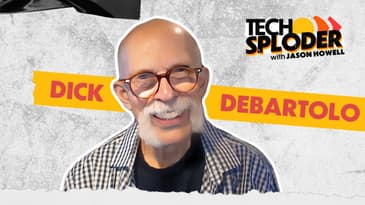


Join Jason Howell as he explores the world of "low-tech" through the eyes of MAD Magazine's Dick DeBartolo, a media legend and true gadget aficionado with a knack for finding humor in the strangest places.
Please support our work on Patreon: http://www.patreon.com/JasonHowell
TOPICS:
- How Dick DeBartolo keeps his humor and fascination with technology, even for mundane gadgets.
- Dick's early interest in technology and how it led to his work at Mad Magazine and game shows.
- The story of how Dick started appearing on TV shows like Metro Media's Saturday Morning Live.
- How Dick transitioned from TV to podcasting with Leo Laporte's TWiT network.
- Dick's favorite gadgets, including the Slingbox and the world's first digital camera.
- The nostalgia and ingenuity behind Dick's early 8mm films with sound effects.
- A memorable story about a private train ride with Mad Magazine's publisher.
- How technology has simplified video production and enabled remote appearances.
Check out The Giz Wiz: https://gizwiz.tv/
Visit Dick's website: http://www.gizwiz.biz
Hosted on Acast. See acast.com/privacy for more information.
[00:00:00] Someone is going to the studio to give Charles Gibson his phone and you are going to live make the first public phone call on the Motorola store. Tech, well, I kept thinking, oh my God.
[00:00:17] This is the Techsploder podcast, conversations with tech professionals about being human in a binary world. Episode seven, Dick DeBartolo. Techsploder is made possible by the financial support of our patrons, like one of our newest patrons, Crystal. If you like what you hear, head on over to patreon.com.
[00:00:36] Slash Jason Howell and support the show directly and thank you for making independent podcasting possible. Hello, everybody, and welcome to the Techsploder podcast. I'm Jason Howell and today I have the honor of chatting with Dick DeBartolo.
[00:00:54] He's a true entertainment legend written for Mad Magazine for over 50 years, appearing in a record 459 consecutive issues. In fact, the longest streak in Mad Magazine's history. He's known as Mads Maddest Rider and he also wrote for classic 1970s game shows like match game.
[00:01:15] Dick has brought his bizarre tech picks to Good Morning America, ABC's World News Now and actually continues to showcase the bizarre side of technology on the long running show, The Giz Wiz.
[00:01:28] Really at the end of the day, Dick is a legend in TV and comics and in technology, even if the tech is as he calls it in this interview, low tech. And he makes me laugh. So let's get right to it. My conversation with Dick DeBartolo.
[00:01:45] How you doing, Dick? It's great to have you. I'm doing good. How about you? I'm doing good. I'm so happy. I'm so happy that we could finally make this work. This show is really just an opportunity for me to talk to people who I adore and who I
[00:01:58] respect and get to know them on a deeper level around the topic of technology. So I had to talk to Dick DeBartolo. OK, I'm very light check. Well, I don't know about that. I mean, I get where you're coming from, but yet a large part like and we'll
[00:02:18] talk about your kind of everything that you've done, because of which you've done a lot that is so unique to probably anyone else's story that I'll get on this show. But but there's a large portion of it that is definitely involves technology.
[00:02:32] It's just not the technology that most reporters are covering, right? Like out there, it's not the iPhone. Yeah, yeah. What happened was technology, there was so much to learn and I'm kind of a goofy guy.
[00:02:48] And I thought I can't learn all this stuff because there's not even enough stuff here to make fun of. So at some point, I just started looking for the real like at CES. Everybody body would run to these mammoth opening speeches and and and here
[00:03:06] hours of specs and and I decided to go down to the basement of CES where all the little startups were people with crazy ideas. And I started covering that and and somehow people sort of like that. I mean, the Gizmo show. Is in year 19. That's crazy. I know.
[00:03:32] And it's gone through a lot of changes over the years. But I love that it's still going. You and of course, Chad, OMG, Chad, on on the Gizmo show. Does he go by OMG Chad or Chad Johnson? He's pretty much Chad now that the red
[00:03:45] on he's he's growing up. Yes, yes, I talked to him not too long ago. I just wasn't sure how he does it on the show. But yeah, Chad's awesome. I love that you guys still have have that going as how has that been?
[00:03:59] Because, you know, for the longest time you were doing the show within the Twitter TV kind of ecosystem. And then you went independent. What what have you seen to be the kind of the biggest? I don't know, the biggest change in transitioning from part of it.
[00:04:17] It's that now it's just Chad and me and a producer. So the fun part is if Chad suddenly has to go somewhere for something, we don't have to phone in and then they find out if the ads can change.
[00:04:32] And it's sort of like a mom and it's like a pop and pop operation. So that that part's fun. It's yours. So you make a call exactly. I mean, the money is a lot less. But basically it's just fun.
[00:04:50] And so the thing about my career has always been if the money's not there and it's fun, that's fine. That's good. So I've been able to do things that I enjoy even if it's not a moneymaker. Yeah. Yeah.
[00:05:08] And you've kept your humor intact, which I mean, when I think of you and your work, humor is right at the top of the list. Like it seems to be that lightness, that humor, humoristic view on life seems to be core and critical to how you tackle things
[00:05:28] like technology and how you tackle do work with mad. How do you keep engaged with that level of humor, that fascination? Because it really seems like sometimes when you're talking about technology and it might be the least important piece of technology in the world,
[00:05:44] you're still fascinated by it. Even if you're fascinated by it because it's horrible, you know, you still know. No, it's funny you say that because this is probably going to be on this week's Skids With Show is this thing is getting incredible ratings. It's a flashlight.
[00:06:00] But why do you need a flashlight that has yellow, blue, green, a burglar along? It just seems and they call it a key chain flashlight. This is bigger than my key chain. I and it's getting great reviews. I mean, I'm just going to review thinking,
[00:06:21] do you really want all these things? I want a flashlight. You just go, oh, I can see that. Oh, it does the trick. It shows me the thing I can't see without it. Yeah, exactly. I don't need seven colors and a long anyway.
[00:06:37] I mean, it's kind of like a party in a box that attaches to your key chain. Yeah, yeah. I mean, the thing is, the more bizarre things I find, the more fun it is. You know, I found these, you know, about anti motion sickening glasses, anti motion.
[00:06:58] Yeah, stupidly the box says motion sickness, sickness glasses. It's really anti motion. So who would want to put on glasses that give you motion? Yeah, exactly. Exactly. But basically they're 10 bucks and they're big plastic frames
[00:07:15] and they just have liquid in the bottom in a little tube so that as you move, you have a fake horizon. Oh, and I'm reading reviews and people go like 75 percent of I think Avis five stars is that this works for me.
[00:07:36] I mean, they look bizarre because they are big inflated glasses. But and then it has two side things for peripheral vision also with liquid in them. And even it looks weird. You know, I say if you have 10 bucks and you suffer from motion sickness,
[00:07:55] this is an easy thing to buy even if they don't work for you. If it's a possible solution, do it. How does that kind of thing I look for? Yeah, it's so interesting that you mentioned that because I think I saw
[00:08:09] not too long ago that one of the features of the newest version of iOS, Apple's OS for their iPhones is going to include something for motion sickness as well, and it operates under the same kind of thing, although not quite the same
[00:08:25] approach in that it uses the accelerometer, I believe, or some sensor on the phone to determine the direction at which these dots on the screen will flow. So it's kind of counterbalancing in a similar way. If you are sickness or motion sickness when you're looking at your screen
[00:08:44] and, you know, you're moving that it will determine where those dots flow in order to kind of calibrate your brain. Oh, that's great. That's great. So that's interesting. That's a whole like angle of technology that we're tapping into. Absolutely. Absolutely. It is tech.
[00:09:01] Yeah. Very low tech, but it works. Yeah, low tech for a lot of people. Yeah. So your career, I mean, you I would say many people, if they know Dick DiBartolo, they almost certainly know you for your history with Mad and Mad Magazine.
[00:09:20] And did the technology aspect of things, did that did that come into play like early on with with Mad Magazine? Or was that something that really just started much later for an entirely different reason? No, actually, it's kind of weird because when I
[00:09:36] was a kid, I played zero sports. We had a house in Brooklyn and we had a finished basement. And back then there was a place called it was like Radio Shack, but it was called
[00:09:50] Lafayette Radio and you could go buy things and I went and I bought a microphone and I bought some speakers and I bought one of the first tape recorders. I think it was a Wollinsock or a Revere and I made a little studio
[00:10:06] in the basement and somewhere I bought letters and on the wall, it said RDB productions. And it's kind of funny because today, like 65 years later, I'm doing the same thing, but now I have five monitors and
[00:10:27] you know, a Hile mic and so basically my dream as a kid still goes on that I'm still doing this. And what that revert what that worked out in it worked out two different ways.
[00:10:44] One is at Mad if the movie had a lot of technology in it like Star Wars, they would assign it to me because they knew I love gadgets. And then a friend of mine was working working on the match game.
[00:11:03] It was just starting up and he says, you know, they're looking for someone to write some weird stuff for the show called the match game. You want to come down into addition, so I'd write like 200 questions, which I did. And I got hired to do that.
[00:11:19] And the funny thing about working for Goodson Tadmin, I worked on match game for 18 years, but my office was full of gadgets. And one of the producers, Barbara Griff, of To Tell the Truth, said, Dick, I'm leaving Goodson Tadmin. I'm going to a local
[00:11:38] metro media station here in the city and we're starting a show called Saturday Morning Live, an informational kind of offbeat show. And a couple of months in, she called me up and she said, you know, it's suddenly dawned on me, maybe you would be a good guest.
[00:11:55] Would you consider getting some of those gadgets and we'll give you a table? And I said, All right. I said, can I be funny? She said, you can do anything you want. The only requirement is that somewhere along the line people have to learn something.
[00:12:14] So I brought some gadgets down and I had a lot of fun with the host, Bill Boggs. And she said, you know, people like this stuff. You have more? And I said, yes. And she said, can you be on every week? Which I did.
[00:12:31] And then I got a call from the Regis show on ABC. Was I under contract in metro media? And I wasn't. I said, I can do both. And then Regis led to Good Morning America. And then World News Now.
[00:12:50] And then at a press event, I met Leo LaPorte. And he said, you know, you have time after the event. I want to talk to you. And we went to get a drink and listen, I started this network this week in tech.
[00:13:07] And he said, I have a monthly show and I have a weekly show. But I want to have a daily show. Could you do a get a daily show? And I said, yeah, I could do a gadget every day.
[00:13:22] And then I said, also Leo, I said, I rent a warehouse where I put old gadgets that were too much fun to throw out. So one day a week I could do a gadget warehouse thing. And he said, oh, OK.
[00:13:36] So we did that for a bunch of years. And then he started getting more shows. And he said, the editors said, why do we have to edit this for every day of the week? Can't you just do five gadgets on one show?
[00:13:54] So it's a show that we have to edit. So that's when the weekly or the daily Gizwa became the weekly Gizwa. And yeah, well, and you know, the rest with Leo and for sure. Yeah. I mean, a day, a daily show
[00:14:10] that like that is no small feat, even if you work to like simplify and make it as a short or whatever, like that is that's that's a lot of work to keep up that that that momentum and that consistency. Yeah, yeah.
[00:14:25] And not to mention, that's a lot of gadgets. Like I'm amazed that you had enough gadgets to fill that much time. Yes. The worst part was doing the opening and closing in the letter of the week when you did it every day of the week was.
[00:14:37] Yeah. So actually, when we went to. The weekly thing, it turned out to be way easier because you just did an opening and a closing for the five gadgets. Oh yeah. And then at one point, Leo said, oh, you know, I have a great gadget.
[00:14:52] Can I do a gadget once in a while? I said, well, why don't you do a gadget every week? And we'll call it Turn It To An Avenue at Thursday. Turn the table Thursday where Leo does the gadget. And that was great for me because
[00:15:09] there was one less gadget that I had to do. Yeah, no kidding. I mean, you know, again, going back to the hamster wheel analogy, you step on that thing and it's it's next to impossible to step off. How so?
[00:15:22] I guess the question that I have is you obviously you're collecting these gadgets. How are you getting ahold of them? Like our at a certain point, are you known so much or the gadgets that people are sending them to you before that happens?
[00:15:37] Are you just like keeping your eyes posted and like, oh, or maybe you're you're sky mauling when you're flying around like how are you? Yes, all of those things. And the funny thing is when I first started doing it,
[00:15:50] you would have to beg somebody to borrow the the gadget. And and because I was totally not known, my favorite story was at CES. There was a guy who had these fake lanterns you would hang on the wall and it looked like it was a flame.
[00:16:14] And it was some little orange and red LEDs and the little fan and strips of nylon or something look very realistic. And I said to the guy, listen, I'm doing this for ABC and I have four complicated gadgets.
[00:16:33] And I want to end the spot by saying not everything at CES was a lot of technology. Here's just a fun gadget that's only 30 bucks. And the guy said, I'll tell you what I'll do. You buy one.
[00:16:52] And then you tell me when the show is on and I'll watch it. And if you do a good job and you get information about my company out, I'll refund your $30. How does that sound? I said, that sounds like I don't want to do this.
[00:17:15] Yeah, that doesn't sound fun at all. No. Anyway. Yeah, so you did not go through with that. I did not. I did not go through. Yeah. But later to tell the truth, to save agony, I pretty much buy everything.
[00:17:34] I mean, if it's an item that's a couple hundred bucks, I'll ask the manufacturer if I can get a product sample for a limited amount of time. And also, I just it's so fun. I just happen to have on my shirt a little shelter.
[00:17:52] I normally, after I do a spot, especially if it's beneficial to the company, I usually call them up and say, listen, I get gadgets for little shelters. They're bizzars. If you don't want this back, can I donate it for one of their auctions?
[00:18:13] And no one has ever said no. So right. That's basically so expensive gadgets I show and then they go out to the shelter. That's amazing. Yeah, that's awesome. That's a great way to give them second life, right? Exactly. Exactly. Exactly.
[00:18:30] Yeah. So I mean, I run into this sometimes with with phones and have over the years where it's like suddenly like I realized like, OK, so I've got a drawer full of phones like this just feels wasteful. Like, I don't I don't need.
[00:18:44] I don't have a need to like have phones in this in these drawers unused. And so, you know, I've given away. I've donated because it just seems like, you know, and I suppose I do have a small collection of phones as part of my set piece.
[00:18:59] But at a certain point, it's like, I don't need all this technology. Like it needs to have a life beyond me. And they few weeks that it gets coverage on whatever show I'm doing and everything, that's really great that you do that. Yeah, no.
[00:19:14] And then they're fun things. You know, I have a warehouse for this stuff. And then here at the studio, I have Dick's gadget shelves. And it's kind of funny because one of the things I have is the first digital Casio camera for the consumer. It took 30 pictures.
[00:19:38] I believe it had like 10 megabytes of memory, built in memory with the instruction book. If it jams, mail the camera back to Casio. And we will attempt to get your pictures off and reset your camera. And the list price was what's your guess?
[00:20:05] Oh, boy, what year was this? This was, you know, I don't remember the year, but the very first available digital camera. Oh, God. So we're talking, you know, I somewhere. Yeah, one second. I'm going to get the camera. Oh, OK. Yeah. Yeah, go for it.
[00:20:21] I would love to see it. And of course, he knows exactly where to go to find it. And it may. Let me see. OK. Now. All right. This is it. Now, OK, that looks nicer than I thought it was going to look. You know what?
[00:20:48] They invented the selfie. The selfie. There you go. That's pretty slick. No flash. OK. No flash. But one of the earlier digital cameras essentially. The first they claim the first. They claim the first.
[00:21:08] OK, so if I had to throw out a number, I don't know, four hundred dollars, I honestly, I have no idea. OK. The list was nine ninety nine. No way. Wow. And they were selling the first, I don't know, five thousand for five ninety nine.
[00:21:28] So six hundred bucks. Wow. It's kind of a me. I mean, that's why it's hard to get rid of stuff like that. Because it's like so amazing. Yeah, it's like historical for sure. You know, absolutely. I have the original Sony Walkman upon a shelf. The very first.
[00:21:47] That's that's a good one. That's a good one to hold on to. Yeah, I certainly wouldn't get rid of the Sony. But if I had the original. So OK, so I'm amazed by something here, Dick. You've got like a studio at least that we're seeing here.
[00:22:01] And then you've got a place, you know, that you that you store technology as well outside of this room. And actually, I'm just going to show a little video here real quick that you had shared not too long ago that shows the Disney land, which shows
[00:22:18] the kind of some of the tech that you with some of your history wall looks like here, but also the tech that you use to run the show. Yeah, that is where I am right now. OK, so you've got a lot of stuff stored everywhere.
[00:22:34] Do you have like an organizational system? Like you were able to go to that camera super fast and well, that's because that's on that's on on my Dick's warehouse shelf. I am terrible. I went when I get overwhelmed, I take a cardboard box and I throw everything in
[00:22:54] it and I write on it to be filed. How many boxes do you have that say about 30? About. About. Only so that's to get Dick's gadget warehouse shelves. It is the very first atomic clock, which kept terrible time because it checked with the the first radioactive clock.
[00:23:20] It checked with the bolder damn clock once every 24 hours. And it was never on time. I mean, not like your phone and a ride. And right now, it's like every every five seconds. Yeah, that some some old old stuff there and some bizarre inventions
[00:23:43] all the way down on the left lower shelf is a guy invented this thing. You slip your remote control in it. And then it had over the thing you slid these sliders so that there was one slider over volume
[00:23:58] up and down and one slider up over channel up and down so that those were the four buttons you used most. And it was just it was just such a ridiculous thing. I couldn't throw it out to keep you from being being being concerned
[00:24:18] with any of the other unnecessary buttons. Exactly. Exactly. For the person who who has a little trouble seeing. Right. Yeah. Always always hitting the wrong button. You just know the big red is volume up and down and the green is channel up and down.
[00:24:34] Got it. OK. All right. Hey, you know, and a lot of this like some of these technologies, like I said, SkyMall earlier kind of has a SkyMall quality kind of has a you know, home shopping network maybe. Hemika Schlemmer. If you have a yes, exactly.
[00:24:53] Exactly. I mean, endless supply of weird wacky. And that was the great thing. Hemika Schlemmer had a big New York store four blocks from Goodson Todman Productions. So I would go there once or twice a week. And I remember they had the world's first microwave.
[00:25:13] And it was like gigantic. And the opening, I mean, you could maybe make two cupcakes in there with steel. And it was five thousand dollars. And then they had the world's first plasma TV. It would only it could heat your house.
[00:25:36] There was so much heat coming off this TV. But it was the first. The first. It was officially the first. So, you know, important that's that is it. The first you got to start somewhere, I suppose. That is amazing.
[00:25:51] We got to take a super quick break and then we're going to come back and we're going to talk a little bit more about this stuff because I'm sure over all these years, you've got some favorites, you've talked about the Walkman and everything
[00:26:01] or maybe even people have told you they've had some favorites. That's coming up here in a second. All right. So you've been collecting technology over the years. You've been, of course, showcasing it on your show with Chad like we talked about
[00:26:15] earlier. So folks definitely need to check out the gizmos and, you know, get you can still get a kind of a weekly view into some of these technologies that you've shared on the show have things as technology has evolved
[00:26:30] and you get things have gotten smarter and ships have gotten more powerful and memories become abundant and everything. Has that made the world of this kind of level of technology less interesting or has it actually kind of supercharged it?
[00:26:46] Given it's some extra fuel to do more weird, interesting things. You know, I'm finding possibly it's an age thing. But a lot of things have gotten too complicated and by trying to simplify a perfect example, actually, I told this story
[00:27:07] just this past week on Gizmos because it came to mind is there was a guy at CES had a little, a tiny little sound machine and it produced great sound. You couldn't tell that that it was repeating a little white noise machine. And I met him
[00:27:28] the second year and he said, oh, we have a whole new version. I said, well, what changed? And he said, we pay a lot of attention to what our customers want. And he said, you can't believe what they wanted. I said, what? They wanted more knobs.
[00:27:44] And I said, I know why. Because with this little sound machine, you clicked one button to pick the sounds you like. When you found the sound you like, you held that button in and that became the volume control.
[00:28:03] But it you kept forgetting that and it kept changing off the sound. You had gone through 40 sounds to find. Oh, boy, yeah. Yeah. And then I thought, yes, it was way better when one button picked the sound and then two other buttons picked the volume. And
[00:28:23] another guy he had invented the the trash bin as you approach it. It opens up. And I said to him, this is great. So the second year I went back to him and he said, oh, you know, you did that on a Regis and that was great.
[00:28:41] The bin as you approach it, it opens way to see what I have now. I said, oh, OK. The electric paper towel dispenser. Yeah, I know this doesn't sound. Yeah, that. Yeah, like I can understand the walk walk towards a trash can automatically opens
[00:29:01] thing there are many times in which I'm in a kitchen and I have a need for something like that. Yeah, I have that. You know, I have the manual push it down with my foot type thing. And that does the trick as well.
[00:29:11] But so you're going right now. It just kind of sounds. I know. I said so. No, don't touch it. Go to the menu. The menu. Yeah. One sheet or two sheets or three sheets. All right, two sheets. All right, now hit go.
[00:29:32] And I watched the machine and I said, isn't the machine going backwards? And he goes, well, it has to go backwards to find the seam. Oh, God. So it goes backwards and it finds the seam and then it puts out two sheets of paper.
[00:29:49] So I go to rip it off and he goes, no, no, no, rip it off that way. You'll pull the machine over. You have to grab it at the top and slowly I'm thinking, are they it was like eighty nine dollars. I saw it. How is this possible?
[00:30:06] That someone spent all this time. Yeah, wants this. It doesn't sound like there was any sort of any sort of like community testing or our idea of a solution like this. I mean, I think I think with with technology,
[00:30:24] what I've what I've noticed in over the years is that the more complicated we get with a certain syntax or a certain like knowledge base that you have to have in order to do the thing. Like all you're doing is you're taking your large possible amount of users
[00:30:42] and with every bit of complication, you're reducing that to a smaller and smaller pool and a complication, you know, a product like the one you're talking about. Like that doesn't sound like it has any any sort of chance at anything. And if anyone is motivated to buy it,
[00:30:57] they will almost certainly give it a bad review wherever they bought it from or whatever, because it's not practical. Exactly. Exactly. So that's the kind of fun thing. It's technology gone wrong. Yeah. Yeah. Indeed. What what are some pieces of technology that that you've shown
[00:31:18] that I guess that you were surprised that people connected so well with? I mean, you go on these, you know, you've gone on many of these large scale platforms, can't get much wider scale than something like Good Morning America.
[00:31:33] You're reaching a ton of people and you're bringing on this technology. Are the things that you expected to be a bomb that people actually connected deeply with? You know, the I think one of the most nervous Good Morning America, as I ever did was
[00:31:50] they arranged for Motorola was introducing the StarTac. Remember the flip phone? That was a big moment. Oh, I mean, it was an incredible hit. And they were introducing it at CES at a nine o'clock Perce conference. But Good Morning America wanted to do it
[00:32:10] on the show and it would be shown two hours earlier. And the PR guy called and he said, listen, for GMA, no problem that you be the first to show this. And he said, you know what they want to do? And I said, I'm not sure.
[00:32:25] Do you? And he said, yes. He said, we're going to have a person come to your hotel room two hours before the show to give you the phone and show you how to use it. And someone is going to New York.
[00:32:39] I think it was Charles Gibson was hosting the show. Someone is going to the studio two hours before to give Charles Gibson's his phone. And you are going to live make the first public phone call on the Motorola StarTac.
[00:32:56] Well, I kept thinking, oh, my God, this show is live. Anyway, this better work. It fortunately it did. So it was great. So so that part was fun. My favorite gadget, I think of all time was the sling box. The sling box. OK, yes.
[00:33:19] I used to travel a lot and a lot of hotels had like five channels. And with sling box back then sling box, you had it at home. You hooked it to your cable box and your router.
[00:33:36] And then wherever you were, you hooked it up to the TV in the room. And then you had control over your cable box at home. It was wonderful because I could watch ABC News local. And I always thought that was one of the most amazing things ever.
[00:33:53] And I think I think they're in business now, but I don't think they build boxes. I think they just run a big channel or something. Yeah, like I just plugged in sling box on Google and, you know,
[00:34:06] the little blurb that it gives you for the site says the demand for sling box has decreased as a result we are focusing our efforts on continuing to develop and enhance innovative products for dish TV. Oh, OK, OK.
[00:34:20] That sounds like they're doing technology for others at this point. But yeah, that was a big deal. I mean, you know, it wasn't too long ago that we had to really consider how we throw our media around with these new capabilities of the internet,
[00:34:36] allowing us to do things like time shifting and cloud and everything. Yeah, that's that's been a real big, real big change in our habits as a, you know, as users. I mean, I can shoot B-roll for a World News Now spot with with my phone.
[00:34:54] I have this little anchor wireless mic kit. And and even at trade shows, you'll come up and do the thing with my phone and hand over a wireless mic and then someone will come up pushing a cot with cameras on it and lights.
[00:35:11] And I'm thinking like which which one is better? They're probably both, you know, very, very similar, right? Like I've certainly thought about this, especially as I've gone independent. It's like when I do things like this, do I need to bring the big camera set up? I probably don't.
[00:35:25] I probably just bring us bring a phone with a mic. I think what it, you know, and I think to a certain degree, viewers, people who are on the other side of the glass watching, you know, watching the content that we create, they become a lot more forgiving
[00:35:41] for these things and to a certain degree that they're more endeared to the run and gun style approach versus the big kind of overly produced approach. Absolutely. I do this show called GizFizz. It's just a silly show playing match game and stuff.
[00:36:00] And they stopped streaming over at Twitch. So the show, so Chad called me, having said, I'm going to teach you how to use OBS. And I said, Chad is going to be so beyond me. No, no, no. So I learned how to use OBS sort of OK. Yeah.
[00:36:17] And I've done it maybe now, maybe 14 episodes of GizFizz. And I one time got totally lost with what I was doing. And I got several emails saying, you know, there are no mistakes. It's all entertainment when things go wrong. That's entertainment.
[00:36:42] So, you know, why do you say you're sorry that this went wrong when we're just here to be entertained and the mistakes are just a part of it? And I think that's one of the fun things about when you use it, you know, the networks,
[00:37:00] everything you cannot get further apart than a network and a podcast. You know, the first time I went out to CES, they sent out three producers, seven people and we went through the halls and everything. And then on air, they said, Dick,
[00:37:21] you have two minutes and 10 seconds for your first and then two minutes and 11 seconds for your second. I said, you know, there are four gadgets in the second. He said, OK, hang on, hang on, we're going to read to him. OK, not two minutes and 11 seconds.
[00:37:38] You can have two minutes and 16 seconds. Now, oh, wow, thank you. Yes, yes, yes. Glorious extra amount of time. Yes, exactly. Whereas in 2011, I went out to Comic Con. I had won an award and I called Leo was going going to a new studio.
[00:38:01] And I said, you know, I'm in San Diego. Would the studio be finished? And he goes, you know, it's so close to being finished. Just fly up here and we'll do it. And so I was talking. Well, you know, were you producing the very first?
[00:38:19] Gizwiz, I produced for a while. I don't think I produced. Well, maybe. I mean, that was anyway, whatever I know I was producing for a while, but I don't know that I was necessarily producing right when we went into the. OK, all right.
[00:38:32] So the very first time I forgot who was producing. Forgive me. And Lisa said, and where where you got what's the set going to be? And he said, you know, we haven't decided that yet. And Lisa said, well, you know, we're not live.
[00:38:47] You have two hours to decide what the sets going to be. Now, if that was a network, two years would be about where they started thinking about what the set. So that's kind of the fun of podcasting and and all these things.
[00:39:04] They're just so much instant stuff you can stop and say, oh, let's look that up now. So that that's fun. Well, but I think what's what's interesting also to me in hearing you kind of talk
[00:39:17] about these two different worlds is that the broadcast world when it comes to the technology that we have and maybe this is just a testament to how good, you know, the cameras and recording ability are on our phone.
[00:39:30] But I do remember working at CNET, you know, almost 20 years ago and seeing it and having to do radio hits and having to do having to be very, very attuned to the quality and the technology that's used and or sending video clips
[00:39:47] to a TV station for them to repurpose. There's a certain level of quality, whereas now it seems like networks are far more inclined to just let you Skype in and or not. Yeah, but whatever. And it's not 100 percent perfect, but it's easier and so it's good enough or
[00:40:05] or record your bits on your phone. And as long as it looks and sounds pretty good, then it's good enough. I mean, the the expectation, I think, even for those high scale, high pressure environments of like live TV and everything, we think of them as having such
[00:40:20] high expectations and requirements. But I mean, that's even changed. That's been influenced by the level of the tech that we have now. Yeah, absolutely. I now I do world news now, which is the overnight news.
[00:40:32] I like it because it's it's they're very loose over there and a lot of fun. But the producers said, if you want to come in, just do it by Skype. We're fine with that. Don't do it by Zoom. We're fine with that. It's it's great. Yeah.
[00:40:47] Yeah, that's really cool. What is there? Is there a piece of technology that you are nostalgic about from like when you were from when you were younger that you're just like, you know, and maybe who knows, knowing you, I would imagine if you are nostalgic about it.
[00:41:05] It's highly likely that you have it stashed away somewhere just so that you could hold on to it. But is there a piece of technology from maybe your childhood or your younger days where you're like, that's that's kind of like the I don't know,
[00:41:18] the the sprout of this? Well, something that I have two of them in the warehouse. I used to make eight millimeter movies, eight millimeter film. All right. Satires on of movies. I made a musical and a Western and we would show them
[00:41:42] at a hotel or something and they were elaborate. We've rented 1930s rolled voices for the celebrities to arrive in or and the celebrities for all the people from the game shows that gets in time and did. And there was no sound back then, but a company called U-Mig
[00:42:05] made this sound projector that used your tape recorder. So you threaded the tape up and then before it went on to the take up real, it ran through the projector. Now, you couldn't do lip sync because it was not quite accurate enough.
[00:42:26] But you could do sound effects and you could do music. And my movies were usually voice over done by Gene Rayburn, who's the host of a match game. And I always thought it would be a riot is we would be in a ballroom at
[00:42:45] a hotel and Goodson and everybody's there in tuxedos. And I'm up on a table and on the table is another card table. And then there's my little reveal tape recorder and I'm threading this through this projector.
[00:43:02] And I was thinking it's just so Mickey Mouse, but it's kind of just it's just like crazy fun that all these rich people and celebrities are here to watch an eight millimeter film. And then a name you probably don't know, Dorothy Killgallon was a celebrity on
[00:43:25] on the What's My Lime, but she wrote movie reviews in the Journal American, a long deceased newspaper. And she wrote a review like it was people had really missed it. There was a giant opening last night at Del Monaco's and writer,
[00:43:42] producer, Dick D. Bartolio, be hearing his name all and it was just an inside joke that she did it in a back then major newspaper. So all those kind of things are just great fun. Yeah, to be able to have that.
[00:43:58] That's so I love the ingenuity of taking these things, you know, these things that have inherent limitations. The eight millimeter didn't have sound. You were able to figure out the technology that could bring it even though it wasn't
[00:44:13] perfect, I can certainly connect that to a lot of things that I did when I was when I was a kid and obviously technology was a little bit further advanced by that point. But still, sometimes working within, you know, the realm of imperfection
[00:44:27] and, you know, a lack of capability and stuff, you can come up with some really interesting creative things working within those restrictions. No, absolutely. Absolutely. And it's great fun. It's kind of rewarding. Oh, my God. Totally to pull it off. This kind of works. Yeah, absolutely.
[00:44:45] A lot of curiosity there. We are kind of running up against the time, but I wanted to see if I could ask you a non-tech question here and I don't know where this is going to go.
[00:44:57] But I figured of all people, you would be the person to ask this because I'm sure you've told a lot of stories in your time. I the question primarily is I feel like everybody has a story of some sort
[00:45:11] that if you're like at a party and you're in a conversation, you tell this story and you get the people to go, wait a minute, what? Holy cow, really? Is there any story that comes to mind that qualifies there that like you
[00:45:24] could tell at a party and people just are amazed that this actually happened? Yeah. So the publisher of Mad William M. Gaines was kind of crazy. He was he said, I make a lot of money from Mad.
[00:45:42] So that's why he would take us on trips to he took us to Russia and Japan and Italy. And anyway, one day he calls me and he says, write this date down and you'll be gone the entire day. I said, anything else? No. Anyway, so.
[00:46:01] We the day is coming and he said, OK, the day is just go to Grand Central Station and meet me there at nine o'clock. So I go and I said, can I bring Dennis my boyfriend back then my spouse now? He said, oh, yeah, Dennis, yeah, this year,
[00:46:19] he says, especially for you. But so they announced a train to Boston. They'll say, go down to the platform. Don't get on the train. I'm thinking. What? So we're standing there and the metro liner is sitting there and I said, Billy, what's going on?
[00:46:36] He said, just hang on. We hear a train whistle and out of the tunnel, a tiny little switch engine comes out pushing an 1890s observation car on the back of which there are three chefs all in white with the big hat.
[00:46:59] And he said, this is especially for you. You love trains. They're hooking this train up to the metro liner. It's going to Boston. They're going to put it on a siding in Boston. You guys, he said, I'm going to stay on the train.
[00:47:14] He said, you just 12 of us, you guys can go Rome, Boston for seven hours or whatever. And he said, then be back by 7.15. You'll hook it up to the 7.15 metro liner and take us back to Grand Central. I mean, that was one of the most
[00:47:31] unforgettable days of my life. It had an open platform. I mean, it was just a standout. Wow, just incredible. Yeah. So you wanted someone to say wow. And you'd say exactly that sounds that's amazing. Like that's that's an experience that most people will never have. No, absolutely.
[00:47:50] It's just so beautiful. And and do you love Boston? I've never been to Boston. Oh, yeah, Boston is great. Boston's great. Yeah. I have to check it out, but I but I won't be able to check it out that way. So I'm a little sad about that.
[00:48:02] That's OK. That could be your story. Dick Vartolo, it's so wonderful knowing you. I just I really adore you and your work and everything you've done to make people smile and laugh. And yeah, you're just great. I really appreciate you.
[00:48:18] And you know what? I should I'm going to plug just one thing. Yeah, absolutely. Please do that's that's what I was going to do next. I'm one of the advisors, but if you're looking for something to do this summer
[00:48:29] and you're traveling, the Norman Rockwell Museum has a huge exhibit called Museum Gone Mad and it's going to run from June 8th through October 27th. And I shot they shot several videos here.
[00:48:46] So I'll be there video wise and I'm going to do a live zoom thing for them at some point. So that'd be a fun thing if you're traveling around to look up the the dates I gave you Norman Rockwell Museum from June 8th soon to October 27th.
[00:49:06] And that'll be in what where exactly will. Oh, sorry. It's in Stockbridge mass. Yes. That's awesome. Yeah, that's amazing. Cool. And then how can people find the work that you're doing with your shows right now? Is there a place for me?
[00:49:24] OK, GizWiz.tv is where the show is. That's every Thursday, 7 30 East Coast time. And GizFiz, if you like match game and you like old movies that we do just it's just a silly show is Wednesday nights 8 30 Eastern time.
[00:49:41] And that's also what GizWiz.tv and my website is GizWiz.biz. There you go. Cool. Dick, thank you for hanging out with me today. It was a pleasure. I really enjoyed this conversation and yeah, keep it up. Have a great trip.
[00:49:58] And maybe hopefully you'll come back with your wow story. I yes, I've got some wow stories. I hope to come back with a few more. Good. Thank you, Dick. OK, buddy. All right, huge thanks to my guest, Dick Di Bartolo, one of my all time heroes.
[00:50:14] So great to have the chance to talk to him. All right, everybody, I can't do this show without your support. It's plain and simple as that right now is I'm building the show and building the numbers in the audience and everything so that I can attract advertisers.
[00:50:26] Hopefully at some point, the only most direct way that you can support and keep the show going is to visit my Patreon, patreon.com. So I'm Jason Howell and I appreciate you looking at free shows. You'll get in return also early access to videos, a discord community,
[00:50:42] an exclusive patrons only pre-premier live stream. So every week at live stream just for patrons right before each episode premieres for like 30 minutes. It's really a lot of fun. And you can be an executive producer of the show like Jeffrey Maricini,
[00:50:57] John Cuny, Bill Rutter and Katie Lake, if you like, at a certain tier. Anyways, so please take a look over there and thank you for supporting this independent podcast, TextBlooder podcast premieres every Friday at 10 a.m. Pacific 1 p.m. Eastern on the TextBlooder YouTube channel with the audio
[00:51:15] podcast publishing to the feeds later that day, not much later, but don't forget to like, rate, review and subscribe wherever you happen to be. It really does help us out and you can find everything you need to know about the show at TextBlooder.com.
[00:51:29] Thanks again to our guest, Dick DeBartolo. Thanks to you for watching and listening. I'm Jason Howell. I'll see you next week on another episode of the TextBlooder podcast.